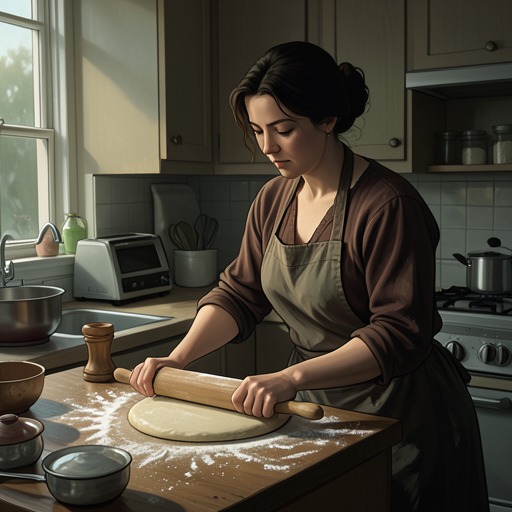
The Wedding Cake’s Enchanted Effect
Like Water for ChocolateThe Wedding Cake’s Enchanted Effect transforms the cake at Rosaura and Pedro’s wedding into a vehicle for grief and longing. Tita’s tears, shed while she prepares its icing, pass into the celebration and overwhelm the guests; Tita alone is untouched. The episode makes private feeling public, while its consequences deepen the conflict between Tita and Mama Elena and leave the wedding marked by sorrow rather than celebration.
Preparation and Emotional Origins
The effect begins in the kitchen, before the cake reaches the guests. Tita is crying, and Nacha urges her to stop and go to bed, explaining that the tears are making the meringue watery and less likely to form properly. Nacha takes over the finishing work. The icing requires ten egg whites and five hundred grams of sugar, beaten to the coarse-thread stage; because of Tita’s tears, Nacha expects it will be twice as difficult to form peaks.
When she tastes the meringue, Nacha finds no apparent change in its flavor. Yet tasting it brings on an intense longing of her own. She recalls preparing wedding banquets for the De la Garza family while hoping that one day she would have a wedding of her own. At eighty-five, that long-deferred hope has become a source of grief: she had been engaged, but Mama Elena’s mother sent her fiancé away. Nacha has spent years helping celebrate other people’s marriages without complaint, but this time the cake’s preparation stirs her loss. She finishes the icing as well as she can, then cries through the night and is too exhausted to help with the wedding the following morning.
The Banquet and the Cake’s Effect
At the reception, Tita’s understanding of the wedding has changed. Despite Mama Elena’s warning that she must stay away from Pedro, Tita now believes that he loves her. Watching Pedro and Rosaura greet guests, dance, and cut the cake no longer troubles her as it once might have. She is impatient to tell Nacha what she has realized, but etiquette requires her to remain at the table until the guests have finished eating. Lost in her thoughts, she does not initially notice the distress spreading around her.
The guests’ first bites of cake bring an overwhelming wave of longing. Pedro, usually composed, struggles to hold back tears. Mama Elena weeps silently, although she did not cry when her husband died. The weeping develops into a broader attack of pain and frustration: guests scatter across the patio, grounds, and bathrooms, grieving their lost loves. The response reaches everyone present, and many become physically ill. The scale of the reaction turns a wedding meal into a collective encounter with remembered heartbreak.
Tita is the sole exception. She finishes her portion without being affected and leaves the party, focused on telling Nacha that she was right about Pedro’s love. Her emotional attention remains fixed on that discovery even as the guests’ misery intensifies around her. The contrast is central to the scene: the cake draws the others into sorrow, while Tita’s hopes about Pedro keep her outside its spell.
Consequences for the Wedding and Tita
Rosaura is among those overcome. She leaves her place of honor and tries to cross the patio without soiling her wedding dress, but slips; the dress is coated with vomit, and she becomes ill in front of Pedro. She bitterly regards the wedding as ruined and remains convinced that Tita put something into the cake. The episode therefore has consequences beyond the guests’ immediate distress: it becomes evidence, in Rosaura’s eyes, of Tita’s supposed sabotage.
Mama Elena reaches the same conclusion. She believes Tita and Nacha deliberately added an emetic to the cake, and punishes Tita. Tita cannot persuade her that the only additional ingredient she added was the tears shed during preparation. Nacha cannot support her account: when Tita goes to find her on the wedding day, she discovers that Nacha has died. Nacha is found with medicinal leaves on her temples and a picture of her fiancé in her hands, details that connect her final appearance to the old heartbreak stirred by the icing.
The wedding’s effects also persist in Rosaura and Pedro’s marriage. Rosaura spends the night in distress, and Pedro postpones consummating the marriage. Months pass before he does so, after Rosaura says she has recovered. Tita does not know that the delay has lasted so long; for her, Pedro’s eventual marital obligation is separate from the realization that he loves her.
Narrative Significance
The cake’s effect binds the scene’s parallel histories of thwarted love. Tita’s tears enter the icing without any deliberate attempt to affect the guests, while Nacha’s tasting of it awakens her own regret about the marriage she never had. At the banquet, the emotion is no longer confined to either woman: it spreads through the guests as physical distress and shared grief. The episode thus presents food not merely as part of a ritual but as the means by which feelings move between people without explanation.
The effect also depends on contrast. Tita’s confidence in Pedro’s love makes the wedding newly bearable to her, even as the cake brings other guests’ losses to the surface. Rosaura interprets the disaster as intentional wrongdoing, and Mama Elena accepts that accusation, so the same event that gives Tita private emotional certainty worsens her position within the family. Its consequences are both intimate and public: a wedding is overwhelmed, Nacha’s hidden sorrow becomes visible through her reaction, and Tita is left without the witness she hoped would share her news.